

II.(Field Note) Monte SommaPhilip Samartzis
(Reading time, 30m17s)Preface
These essays were written during a ten-day residency in Somma Vesuviana in June 2026.
I arrived interested in how communities inhabit landscapes shaped by instability and uncertainty. During my stay, however, these conditions rarely appeared directly. Vesuvius was frequently discussed, occasionally glimpsed and continuously present, yet for much of the residency it remained concealed behind the rim of Monte Somma.
The residency was hosted by Tramandars, a cultural organisation based in Somma Vesuviana. Its president, Tani Russo, met me on arrival in Naples. During the drive to the town, he spoke about the region's long association with the Grand Tour and his desire to develop a counter-narrative to its emphasis on spectacle and fleeting encounters with place. The conversation framed my understanding before we entered the medieval town.
In previous conversations, another aspect of Somma Vesuviana surfaced. Baccalà, salted cod from the Lofoten Islands above the Arctic Circle, was repeatedly associated with the town. Before it is eaten, the fish is immersed for several days in mineralised water from Monte Somma, where it is gradually restored after its long preservation in salt. The relationship between the two places is never explained.
The essays trace places, practices and conversations encountered during the residency. They move through the streets of Borgo Casamale, archives assembled across generations, vineyards maintained through continual labour, pathways leading into the mountain and songs passed from voice to voice.
Certain observations recurred. Sounds often arrived before their source became visible. Earlier settlements remained buried beneath volcanic deposits. Water moved invisibly through the mountain before reappearing elsewhere. Fragments of walls, roads and buildings emerged intermittently from vegetation. None of these observations seemed especially significant in isolation.
Together they suggest relationships that are less easily defined. The essays were written to preserve something of those encounters before experience settled into memory.
Within the Walls
The apartment occupies two levels within a multi-storey building in Borgo Casamale. Entry is directly from the street. A door opens into a large room functioning simultaneously as kitchen, living area and exhibition space. Outside, the street narrows between stone buildings. Inside, artworks, records, photographs and domestic objects occupy a single open space. Nothing clearly distinguishes residence from workspace.
The lower level is surfaced in a cushioned vinyl flooring that yields slightly underfoot. Unlike the stone and tiled surfaces elsewhere in the apartment, it absorbs rather than returns sound. A Stanton T.60 turntable stands beside a stack of records. The uppermost sleeve is Lou Reed’s 1972 debut solo album. Photographs and printed material are pinned to noticeboards. Objects occupy shelves, tables and alcoves. Records, artworks and domestic objects coexist without any obvious hierarchy.
Many of these objects predate my arrival and will remain after my departure. Their presence suggests lives, interests and activities that are only partially accessible to a temporary occupant. The apartment is inhabited, yet also provisional, suspended between ongoing use and temporary occupation.
During the day the interior is shaped primarily by reflected light. Opposite walls stand only a short distance from the windows. Their surfaces are marked by decades of exposure and repair. Plaster has detached in irregular sections. Moisture has left dark traces beneath rooflines and gutters. Earlier surfaces remain visible beneath more recent interventions.
Small balconies project from several windows. Their metal railings are worn and rusted. Layers of paint have deteriorated through prolonged exposure to weather. Too narrow to occupy comfortably, they function as extensions of the windows, suspended between interior and street.
The windows themselves are fitted with iron bars. Looking outward involves looking through them. A doorway. A parked car. A fragment of balcony. A section of masonry. The town appears in fragments.
A staircase rises from the rear of the apartment. Pale marble steps ascend towards the upper floor. The stone continues along a corridor connecting the rooms above. During the afternoon light gathers across its polished surface before gradually receding towards evening.
The upper floor is organised around a large studio overlooking the street. Timber floorboards cover the room. A substantial table occupies the centre of the space. Microphones, recorders, notebooks and cables are arranged across its surface.
Nearby stands a tall pole decorated with flowers, ribbons and balloons. Extending almost to the ceiling, it rises above the surrounding objects. Its purpose remains unclear. Whether commemorative, festive or devotional is difficult to determine.
One window overlooks the Collegiata di Santa Maria Maggiore. Its bell tower rises above the surrounding roofs less than twenty metres from the apartment and approximately thirty metres above the studio. When the bells sound, they descend through the surrounding streets and courtyards before entering the apartment through open windows.
Opposite the apartment, at a slightly higher elevation, a bar occupies a medieval courtyard shaded by trees. During the day the courtyard remains largely empty. Tables and chairs wait beneath the canopy. By evening voices begin to occupy the space.
From the studio, individual sounds become the primary subject of attention. A footstep crossing stone. A conversation passing beneath a window. The brief acceleration of a scooter. A car negotiating the narrow street. A mobile phone held close to the ear. A reversing truck entering from beyond the church. Each sound possesses a distinct character shaped by its source, distance and trajectory.
The physical structure of Borgo Casamale alters these sounds continuously. Stone walls compress and return them. Courtyards diffuse them. Open windows admit them. Iron railings and balconies interrupt and scatter them. Some sounds arrive with remarkable clarity. Others lose definition as they move through the surrounding streets. Sources frequently remain hidden from view.
Among the photographs and notes pinned to a noticeboard is an image of a mostly naked woman ascending Valle dell’Inferno. A veil drapes across her body as she glances back over her shoulder towards the viewer. One hand gathers the fabric while the other appears to gesture upwards. The scene is set within the steep volcanic depression separating Monte Somma from Vesuvius. No explanation accompanies the image.
Beyond the studio, a smaller bedroom and bathroom occupy the remainder of the upper floor. The bathroom is modest and functional. White tiles cover the walls. A small window opens towards neighbouring buildings. The toilet is installed without a seat. The hard surfaces produce a pronounced reverberation. Even small sounds persist briefly within the room before dissipating.
As evening progresses, the density of activity fluctuates. Voices emerge and recede. Vehicles appear intermittently. Conversations pass between balconies and windows. Individual events overlap before separating once again. No single sound dominates the field for long.
Several hours after the courtyard has emptied, the character of the neighbourhood changes. Longer intervals emerge between events. Individual sounds become easier to isolate.
Much later, bats begin to move through the spaces above the roofs. They are rarely visible. Their presence is announced by brief clicks passing between walls, chimneys and balconies before disappearing again into the darkness.
Beneath the Volcano
The bells of the Collegiata di Santa Maria Maggiore sound briefly before sunrise. Their resonance moves through Borgo Casamale and across the former Aragonese Walls before fading into the slopes of Monte Somma. The signals are short and functional. They mark the beginning of the day rather than announce an event. A second sequence follows later in the morning. Between these intervals other sounds emerge: scooters moving through narrow streets, conversations passing between balconies, dogs barking behind gates, swifts crossing above tiled roofs. Sound often arrives before the source becomes visible.
Situated on the northern slopes of Monte Somma, Somma Vesuviana occupies a different position within the Vesuvian landscape from that usually presented to visitors. Since the eighteenth century, the region has often been understood through the spectacle of Vesuvius. Travellers undertaking the Grand Tour climbed the volcano, observed eruptions and documented the ruins of Pompeii and Herculaneum. Attention was directed towards catastrophe and antiquity. Borgo Casamale suggests another perspective.
The medieval centre remains organised around a system of streets and walls that continue to structure daily life. Sections of the fifteenth-century Aragonese Walls survive throughout the district. They emerge unexpectedly between houses and gardens before disappearing behind later construction. In places the walls have been repaired. Elsewhere they are fractured by vegetation or obscured beneath layers of plaster. Their condition resists simple classification as either monument
or ruin.
The stone from which these structures are built appears repeatedly throughout the town. It forms retaining walls, staircases, churches and property boundaries. Similar material can be found on the slopes of Monte Somma above the settlement. The distinction between mountain and town becomes less clear the longer one remains. Volcanic material has been quarried, transported and incorporated into the built environment over centuries. The town is not simply located beside the volcano. It is partly constructed from it.
Few Grand Tour travellers would have lingered here. Their attention was directed towards eruptions, ruins and panoramic views. Borgo Casamale presents a different encounter with the Vesuvian landscape, one grounded in habitation, maintenance and continuity.
The acoustic character of Borgo Casamale is closely tied to these material conditions. Narrow passages compress voices and footsteps before releasing them into courtyards and wider streets. Bells, conversations and passing vehicles rarely travel in straight lines. Instead, they bend around corners, disappear behind walls and re-emerge unexpectedly elsewhere. Listening often reveals spatial relationships that are not immediately visible.
Monte Somma remains visible from almost every part of Somma Vesuviana. The mountain appears beyond garden walls, at the end of streets and above clusters of houses. Residents often describe it as a form of protection. As the surviving rim of an older volcanic structure, it is understood to provide a barrier between the town and Vesuvius. This understanding exists alongside scientific assessments of volcanic risk and forms part of a broader local relationship to the landscape. Monte
Somma is not simply topography. It is one of the town’s guardians.
The Madonna occupies a similar position.
Her image appears repeatedly throughout the town: in churches, domestic shrines, confraternities and niches embedded within street corners. On Via Botteghe a small figure stands within a recess cut into a weathered wall. The surrounding plaster has cracked and fallen away in places. A lamp remains illuminated beneath the statue. Potted plants occupy the ledge below. These sites are encountered without ceremony. They exist alongside parked vehicles, electrical cables and domestic architecture. Yet they contribute to a geography of protection that extends throughout the town.
Neither Monte Somma nor the Madonna eliminates risk. They simply allow it to be lived with.
Near the centre of Borgo Casamale stands the Collegiata di Santa Maria Maggiore. The church occupies a pivotal position within the medieval settlement, situated where many of its principal routes converge. The historic east–west axis connecting Porta Piccioli and Porta Marina passes through the churchyard, while north–south streets extend from the adjoining square. As a result, the building functions as more than a landmark. It remains one of the organising coordinates of the historic centre, a point through which movement, orientation and daily life continue to pass.
Adjacent to the church, behind a gate marked by a wooden cross, lies the preserved body of a monk. Historical explanations vary. Residents refer to him matter-of-factly. Visitors pause briefly before continuing along the surrounding streets. Neither monument nor museum object, the monk remains integrated within the daily geography of the town.
A short distance away, the seventeenth-century Chiesa e Convento delle Alcantarine occupies part of the former defensive perimeter. Built into the line of the Aragonese Walls, the convent illustrates the gradual accumulation of functions that characterises Borgo Casamale. The town expanded not through replacement but through adaptation.
This process is perhaps most visible in the home of Domenico Russo.
A retired physician and local historian, Domenico has assembled an extensive archive devoted to the history of Somma Vesuviana and the Vesuvian region. Books occupy almost every available wall. Shelves extend from floor to ceiling. Hundreds of carefully organised archival volumes contain documents, photographs, maps and records relating to the town and its surroundings.
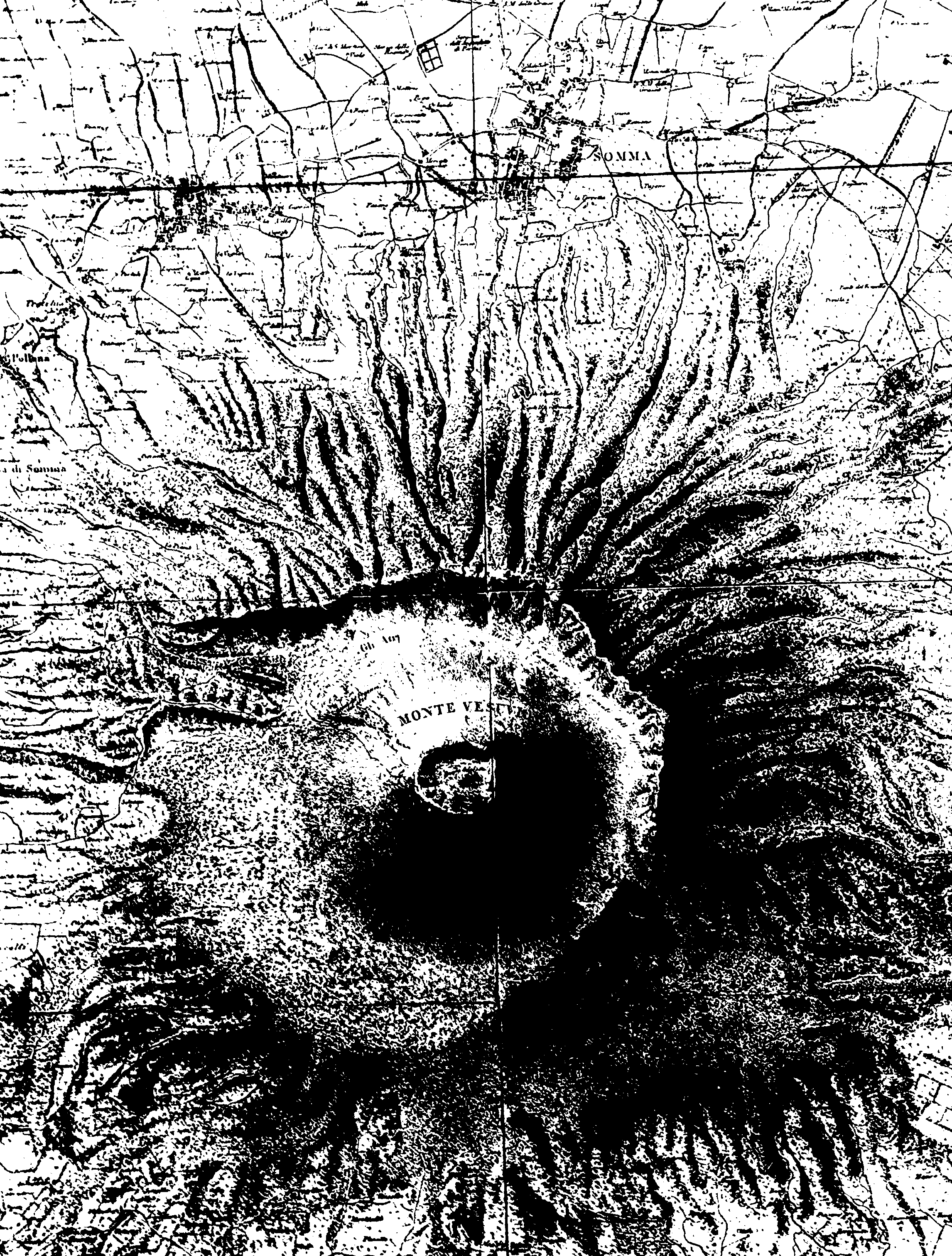
Alongside these materials hangs an extraordinary collection of images depicting Monte Somma and Vesuvius. Early engravings, historical maps, nineteenth-century illustrations and contemporary photographs coexist within a dense visual arrangement that covers entire rooms. Some images depict eruptions. Others record changing representations of the landscape across centuries. Together they form an alternative history of the region assembled within a domestic setting.
Leaning against a bookshelf in one corner is a large framed poster titled Operazione Vesuvio. Produced in the early 1970s under the direction of the French critic Pierre Restany, it imagines the volcano as a site of artistic experimentation and cultural enquiry. While many images in the archive look backwards, the poster appears to address a future that had yet to arrive. More than fifty years later, it remains difficult to determine whether the poster records a historical moment or anticipates one.
The collection does not emerge from visitation but from residence. The Russo family traces its presence in Somma Vesuviana back several centuries. Rather than documenting singular encounters with the volcano, the archive records generations of sustained attention to place. Monte Somma and Vesuvius appear repeatedly, not as spectacles but as permanent companions to everyday life. The collection functions as a counterpoint to the visual culture of the Grand Tour. Its emphasis is not discovery but continuity.
A phrase painted on a wall within the historic centre reads: “A people without traditions is like a tree without roots.”
The statement appears on a weathered surface marked by moisture, peeling plaster and traces of repair. Nearby, the Aragonese Walls continue around Borgo Casamale before disappearing behind houses and gardens. Beyond them rises Monte Somma.
The phrase functions less as a slogan than as a description of the town itself.
Bells mark the hours. Festivals return each year. Archives accumulate across generations. Monte Somma records processes unfolding across millennia. These different measures of time coexist within the town as ordinary features of daily life. Roman foundations support medieval walls. Volcanic stone becomes architecture. Shrines remain illuminated. Archives continue to expand.
From this perspective, Somma Vesuviana appears less concerned with the dramatic episodes that dominate accounts of the Vesuvian region than with the longer processes unfolding between them. The volcano remains present throughout, encountered less as spectacle than as material, memory and condition.
Beneath the volcano, daily life continues.
Along the Slopes
The road leaving Somma Vesuviana climbs gradually towards Contrada Maresca on the northern slopes of Monte Somma. Houses become less continuous. Vineyards occupy the spaces between orchards, woodland and small cultivated plots. The mountain remains visible through gaps in the vegetation rather than as a single dominant form.
The transition is marked less by altitude than by maintenance. Some properties remain carefully tended. Vines are pruned. Orchards are cultivated. Access roads remain passable. Nearby, other plots appear to have slipped beyond regular care. Vegetation obscures former boundaries. Structures disappear beneath growth. The distinction between cultivated and uncultivated land becomes increasingly uncertain.
The roads reflect these conditions. Sections of asphalt have deteriorated into compacted earth, gravel and exposed stone. Deep ruts cut through the surface. Vegetation presses in from both sides. Discarded materials and domestic rubbish accumulate along verges and embankments. During periods of heavy rain, access can become difficult and sections of the route may become temporarily impassable. The landscape remains productive, though not uniformly maintained.
The vineyard belonging to Domenico occupies one of the more carefully tended parcels. Rows of vines follow the contours of the terrain beneath a network of metal trellises. Concrete retaining walls negotiate changes in elevation. Beyond the cultivated sections, dense vegetation advances across neighbouring plots. Maintenance and neglect exist side by side.
Among the vineyards stands a stone building. Vines extend almost to its walls. Openings expose an empty interior. Vegetation advances across sections of masonry. The structure remains intact yet appears detached from any obvious purpose. Whether awaiting repair, reuse or further decline is difficult to determine. It occupies an uncertain position within the landscape, neither fully abandoned nor actively maintained.
Beneath this landscape lie earlier occupations. Prior to the eruption of AD 79, the northern slopes of Monte Somma supported Roman villas and agricultural estates. Subsequent eruptions buried many of these structures beneath volcanic deposits. Archaeological excavations around Somma Vesuviana continue to reveal fragments of buildings, roads and cultivation systems concealed below the present surface. Earlier occupations remain embedded within the volcanic terrain, periodically reappearing before disappearing once again beneath layers of volcanic material.
Similar traces persist above ground. Towers, fortified structures and fragments of masonry appear intermittently between woodland, houses and cultivated fields. Some occupy elevated positions overlooking routes into the mountain. Others emerge unexpectedly through vegetation before disappearing again.
Water is rarely visible. Domenico explains that the vineyard receives water from subterranean flows moving through the volcanic geology of Monte Somma. Rainfall enters the mountain before reappearing elsewhere through gravity and porous volcanic strata. The system remains largely invisible. Its presence is inferred through the productivity of vines, orchards and cultivated plots. Like many processes shaping the Vesuvian landscape, it becomes apparent through consequences rather than direct observation.
The labour required to sustain this productivity remains equally easy to overlook. During the visit, Domenico moves repeatedly between rows carrying heavy buckets of water. The task appears routine rather than exceptional. The vineyard depends upon a succession of small actions repeated over time. Its continued productivity emerges not simply from favourable conditions but from sustained attention.
Sound behaves differently here than in Borgo Casamale. Distances increase. Individual events occur less frequently. Birds occupy different levels of the vegetation. Insects remain active throughout the vineyard and surrounding woodland. Sounds from Somma Vesuviana arrive intermittently from below as faint traces of traffic, bells and human activity carried across the intervening terrain.
Beside the vineyard, Domenico briefly burns a small pile of pruned vines and dry vegetation. For several minutes the crackling of stems introduces another layer into the otherwise continuous sounds of birds, insects and distant activity from the town below. The fire subsides as quickly as it appears.
Among the grape varieties cultivated in Contrada Maresca is Catalanesca. Local accounts often connect the grape to Catalonia and the period of Aragonese influence in southern Italy, although its precise origins remain uncertain. Whatever its provenance, the variety became embedded within local agricultural practice and is now closely associated with the slopes of Monte Somma.
Later, Tani describes vineyards as being nursed rather than cultivated. The vines require continual attention, adjustment and protection. Their continued productivity depends upon forms of labour that often remain unnoticed.
Roman villas remain buried beneath cultivated ground. Fortified structures overlook orchards and vineyards. Productive plots sit beside land reclaimed by vegetation. Roads continue upwards through erosion and accumulated debris. The landscape remains occupied, though not always in the same way.
Within the Ruins
Roadworks redirect traffic through temporary routes on the approach to Pompeii. Cars advance slowly between construction barriers before stopping again at narrowed intersections. Parking attendants stand beside entrances gesturing towards approaching vehicles. Apartment buildings, restaurants and commercial premises extend along the main roads. Fragments of masonry appear intermittently beyond fences and walls before disappearing again behind contemporary buildings.
The archaeological site reveals itself gradually.
Prior to arriving, I had understood Pompeii primarily through images of excavation and ruin. The town presents a different condition. Ancient and contemporary structures occupy the same terrain. Visitors move between restaurants, parking areas and archaeological remains. The distinction between past and present proves less stable than expected.
Earlier that evening, the journey from Somma Vesuviana to Pompeii followed a circuitous route around the southern edge of the Vesuvian landscape. The road passed through a mixture of cultivated plots, vacant land, small industrial premises and dispersed settlements. As daylight faded, the landscape appeared suspended between multiple forms of occupation.
It was during this journey that I encountered Vesuvius for the first time.
Throughout my stay in Somma Vesuviana, the volcano itself had remained concealed behind the rim of Monte Somma. Its presence was rarely in doubt, yet it remained largely unseen. The profile that emerged during the drive south was therefore unexpectedly disorientating. It was immediately recognisable from paintings, photographs and popular representations of the volcano, yet entirely unfamiliar in experience.
For several days I had inhabited a landscape organised around a mountain I had never actually seen.
By the time I enter the archaeological site, the fleetingly glimpsed volcano has disappeared once again into darkness.
The route towards the Teatro Grande passes through excavated streets and roofless buildings illuminated intermittently by artificial lighting. Beyond these areas the site remains largely invisible. Walls emerge briefly before disappearing again into shadow. Small groups move in the same direction through the archaeological precinct. Their conversations become audible before fading once more into the surrounding darkness.
The theatre occupies a shallow depression within the site. Stone terraces rise above the stage in successive rows. Looking beyond the upper seating reveals little. Darkness conceals the boundaries of the surrounding ruins.
The first voice emerges from the stage.
Its position is immediately apparent.
A second follows from beneath the stage itself.
The distance between performer and audience is considerable, yet the voice retains remarkable clarity. Breathing, inflection and subtle changes in tone remain intact. As the performance progresses, other voices emerge from different locations. Each occupies a distinct position within space. What becomes apparent is not volume but precision. Sound retains its location. Listening repeatedly shifts towards the exact point from which a sound originates.
The performance is The Bacchae.
Throughout the evening, Dionysus is encountered primarily through his effects. Voices, gestures and disturbances accumulate around a presence that is often discussed before it is fully revealed. Beyond the theatre lies the city destroyed in AD 79. Beyond that rises Vesuvius. Like Dionysus himself, each is understood primarily through its consequences.
The chorus occupies the stage in changing formations. At times individuals separate from the group. At others they move as a collective body. Speech forms only part of their presence. Exhalations, gasps, cries and sustained vocalisations accumulate beneath the dialogue. Breathing becomes increasingly audible. Individual voices dissolve into larger formations before separating once again.
The resulting sounds resemble neither language nor music. They function instead as a shifting acoustic texture extending throughout the theatre. Attention moves repeatedly away from the narrative and towards the sounds themselves. Air moving through bodies. Breath transformed into utterance. Individual voices merging into a larger field before dispersing again.
Amplified percussion and electronic sounds establish an atmosphere of unease. Their role remains largely environmental. The voices behave differently. They preserve their position within space. The theatre appears unusually responsive to these details. Even the smallest vocal gestures remain intelligible across distance.
Much of Pompeii survives as fragments. Roofs have disappeared. Walls terminate abruptly. Streets lead towards buildings that no longer exist. Yet the acoustic behaviour of the theatre remains remarkably intact. Nearly two thousand years after the eruption of AD 79, the structure continues to organise sound with extraordinary precision.
During the performance, attendants carrying torches move through the audience towards a spectator requiring medical assistance on one of the terraces. The drama continues uninterrupted. Voices from the stage remain audible above the movement occurring within the crowd. Later, as the audience departs, a second person collapses on the steep stone steps leading from the theatre. Attention briefly shifts towards the gathering of attendants and paramedics before dispersing once again into the surrounding darkness.
Stone, darkness, heat and gravity continue to shape the experience of those who enter it.
As the performance concludes, the audience disperses through the archaeological site. Small groups ascend the terraces and disappear into excavated streets and passageways. Conversations replace the sounds of the chorus. Phone screens and torches move briefly between walls before vanishing into darkness.
The stage is empty.
The illuminated circle remains for several minutes after the audience has departed.
Beyond it, the ruins retreat once more into darkness.
Towards the Summit
Shortly after six, Salvatore Aliperta collects me from the apartment in Borgo Casamale. We stop to collect Vittorio D’Avino before driving towards Santa Maria delle Grazie a Castello on the upper slopes of Monte Somma. At a petrol station nearby we drink cappuccini and eat cornetti. Several older men occupy tables on the terrace. They greet Salvatore as we arrive. Their conversations continue as the town slowly begins to wake. By 6.30am the car is parked beside the woodland.
Beyond the clearing, the path enters the mountain.
For most of the ascent Monte Somma remains invisible.
Trees arch across the trail. Vines extend between trunks. Ferns occupy embankments and depressions. Dense vegetation obscures distances and limits orientation. The path reveals only short sections ahead before turning, climbing or disappearing once again into woodland. Unlike Vesuvius, which presents itself as a recognisable volcanic form, Monte Somma is encountered incrementally through gradients, surfaces and vegetation.
The trail rises steadily through loose volcanic material. Pumice, gravel and fractured stone shift beneath each step. The gradient remains consistent rather than dramatic. Progress is measured less by distance than by accumulation. The mountain is not climbed so much as entered.
Birds occupy different levels of the forest. Calls emerge from the canopy before moving elsewhere through the vegetation. At one point the call of a falcon carries through the canopy. Salvatore identifies it immediately, though the bird itself remains hidden somewhere above the trees. Occasionally other sounds enter the woodland from beyond it. An aircraft passes overhead. A vehicle moves through the valley below. These interruptions remain infrequent. Most of the ascent is accompanied by birds, insects, footsteps and the movement of vegetation in the wind.
The vegetation changes gradually with elevation.
Clusters of yellow flowers appear repeatedly beside the path. Further upwards, inflated seed pods hang amongst the foliage. Salvatore identifies them as species associated with the mountain. At one point he demonstrates how one of the pods produces an unexpectedly flatulent sound when compressed. Laughter moves briefly through the forest before dissolving once again into birdsong and footfalls.
The mountain reveals itself through such details.
There are no panoramic views. No clear sightlines towards the summit. The forest remains largely self-contained. Light enters intermittently through openings in the canopy before being absorbed once again by vegetation. Fallen branches accumulate beneath undergrowth. In places the woodland appears carefully maintained. In others it seems to be advancing across the mountain unchecked. Trees, vines and shrubs intertwine to form dense structures through which the path has been cut.
Only occasionally does the volcanic origin of the terrain reassert itself through exposed sections of stone and eroded embankments.
Occasionally evidence of earlier passage emerges from the vegetation. A weathered trail marker appears beside the path. Further on, a partially obscured stone inscription sits amongst the undergrowth. Their surfaces suggest long exposure to the elements. The mountain is heavily vegetated yet traces of those who have moved through it remain visible.
Conversation remains limited. Salvatore and Vittorio speak to one another in Italian as we climb. Their exchanges are warm but intermittent. Long passages pass in silence. The language barrier alters the walk, shifting attention towards gesture, pace, vegetation and sound.
Salvatore’s role remains central. As president of the Associazione Amici del Casamale, he maintains an active relationship between Borgo Casamale and Monte Somma. His knowledge of the path, the vegetation, the summit structures and the traditions associated with the mountain gives the ascent its form. The walk proceeds through guidance rather than explanation.
After nearly two hours the character of the ascent begins to change.
The vegetation thins. Distances increase. Structures start to appear.
A large metal cross emerges between the trees. Further along stands a small devotional shrine constructed from volcanic stone. Candles, flowers and religious objects occupy its interior. Nearby is a simple shelter built from timber and corrugated metal. Weathered benches line its interior. Salvatore explains that the structure is used during gatherings and activities on the mountain.
Beyond them the woodland finally opens.
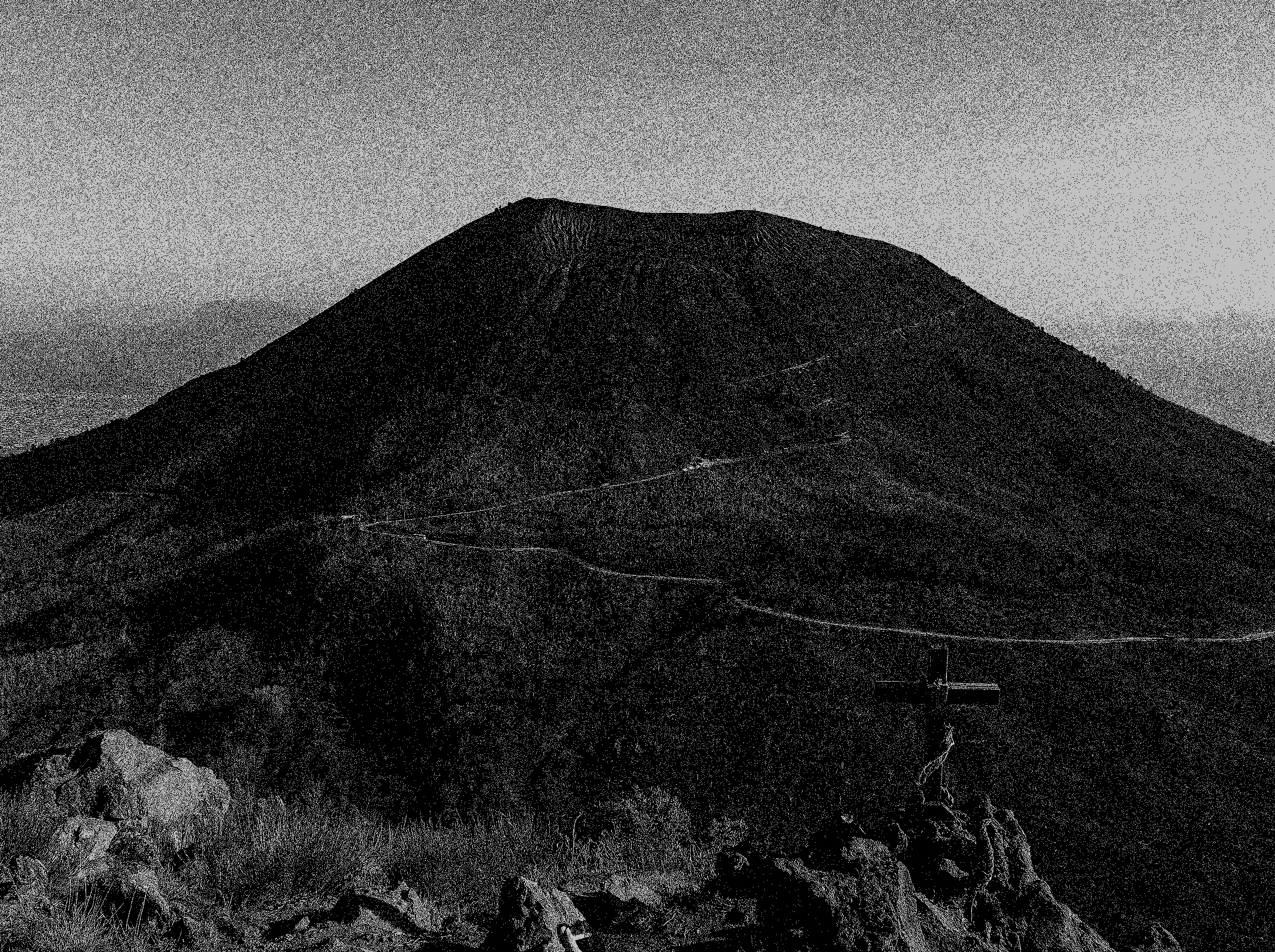
For the first time the upper slopes of Monte Somma become visible. The path continues towards Punta Nasone, the highest point on the mountain. Across the intervening valley rises Vesuvius. Seen from Monte Somma, the volcano occupies a different position within the landscape. It no longer appears as an isolated mountain but as part of a larger geological structure whose scale becomes apparent only from the older rim. The depression between them, known as Valle dell’Inferno, reveals the relationship between the two volcanoes more clearly than anywhere else encountered during my stay. Salvatore points towards locations associated with the American military presence during the Second World War.
Near Punta Nasone stands a white marker.
Vittorio positions himself beside it and begins to play.
The tammorra establishes a pulse that carries across the summit before dispersing into the surrounding air. Three songs are performed and recorded during the morning. Their meanings remain largely inaccessible to me. My understanding of the tradition comes only through fragments gathered during earlier conversations in Somma Vesuviana. Yet their connection to the mountain is unmistakable.
Vittorio sings with a conviction that requires no translation. Voice, percussion, wind, insects and distant environmental sounds occupy the same acoustic field. At intervals buses can be heard moving along the tourist routes on Vesuvius opposite. Their presence remains peripheral. Attention repeatedly returns to the performance.
The audience consists of three people.
The recordings themselves are relatively few.
Aside from the performances at the summit and a recording of woodland birds made during the descent, most of the day is devoted to listening. Equipment remains packed away for long periods. Sounds are not collected so much as encountered.
The summit remains occupied for only a short period.
Soon afterwards we begin the descent.
We turn our backs on Vesuvius and re-enter the woodland. The summit structures are passed once more before being absorbed into the forest. Within a short distance the wider landscape disappears from view. Birds reoccupy the foreground. The mountain returns to fragments: a section of trail, a cluster of flowers, a voice somewhere ahead, the sound of loose stone moving beneath a boot.
By midday we have returned to the vehicle waiting below.
Only afterwards does it occur to me that the path we followed has connected Somma Vesuviana to Monte Somma for centuries.
Farmers, shepherds, woodcutters, pilgrims and local residents moved repeatedly between town and mountain. The route followed that morning forms part of a much longer history of passage through the landscape.
The songs performed at the summit belong to this continuity.
Later, Vittorio and Tani explain that the songs belong to an oral tradition once heard in the countryside, on the streets of Naples and outside prison walls. They carried messages, emotions and sometimes coded meanings between those separated by distance or circumstance. Passed from voice to voice rather than through notation, the tradition survives through memory and performance.
Back at the apartment, I pour a small glass of nocino. Franceschina, an elderly neighbour who lives further down the street, had given it to me the previous day. It is intended to restore energy. After six hours on the mountain, this seems an appropriate moment to drink it.
Vesuvius
Vesuvius remains one of the last places I visit.
Only three thousand visitors are permitted onto the mountain each day. By the time we arrive, all available tickets have been allocated. Most appear to have been purchased through tour operators. We wait until the final admission period before gaining access to the summit area.
The mountain is quieter than expected.
Many visitors have already begun their descent. The path remains occupied, though not densely. There is little sense of the crowds often associated with the site.
The ascent follows a broad volcanic slope towards the crater rim. Information boards describe earlier eruptions and geological processes. Fences define the route. A loudspeaker is mounted above the entrance gate. Further along, monitoring equipment occupies several locations on the upper slopes. Geophones have been installed near the crater rim. Nearby, devotional images and shrines have been attached directly to the volcanic rock.
For much of my stay in Somma Vesuviana, Vesuvius has remained concealed behind Monte Somma. Its presence has been constant yet largely indirect. The volcano appeared repeatedly in conversations, archives, songs and local histories long before it appeared as a visible landmark.
From the summit path, only sections of the crater are initially visible.
Exposed strata circle the interior of the volcano in uneven bands of colour and texture. Sections of the inner wall appear fractured and unstable. Loose material accumulates below steeper slopes. Erosion channels cut through the volcanic deposits. Vegetation has established itself in some areas while disappearing from others.
The crater records processes unfolding across multiple temporal scales. Layers formed through eruption, deposition and collapse remain visible within the exposed geology. Yet the profile of the volcano is far from fixed. Weather, gravity and erosion continue to reshape its surface. The terrain appears less permanent than provisional.
The summit is unexpectedly quiet. Most visitors have already departed and the path is only lightly occupied. By the time I reach the summit, only a short period remains before visitors are required to descend again.
There is no time to make sound recordings. Instead, I take photographs.
A low rumble echoes through the crater.
At first, I assume it originates from the volcano itself.
Only when darker clouds begin to gather overhead does its source become apparent.
Thunder.
The sound reverberates around the crater walls before dissolving into silence. Between these intervals, little can be heard. Occasionally the call of a falcon carries across the summit before disappearing once again.
Looking beyond the volcano towards the mountains inland from Naples, streaks of lightning appear in the distance.
After a short period, security staff begin directing the remaining visitors from the summit. Most have already departed. Within a short time, the upper slopes are largely empty.
The previous day, over lunch, Tani had shown me a nineteenth-century lithograph titled Discesa dal Vesuvio depicting travellers descending Vesuvius. The image is crowded with figures. Men and women in formal dress scramble across a steep volcanic slope while guides attempt to direct their progress. Movement appears precarious. Order is difficult to locate.
The image remained with me.
Perhaps because it was the first Grand Tour representation I had encountered during my stay.
Perhaps because it appeared shortly before my own visit to the volcano.
The descent I witness is altogether different. Visitors move steadily along designated paths. Fences define the route. Access to the summit is carefully managed.
Above us, sections of the crater wall appear fractured and unstable. Fresh landslips interrupt the volcanic strata.
Geophones continue to monitor activity from the crater rim.
Below the summit, Valle dell’Inferno opens between Vesuvius and Monte Somma.
Above the entrance gate, the loudspeaker remains silent.
The bus shelter, empty.
Dust settles across the surrounding carpark.
Late Afternoon
On the afternoon before my departure, a thunderstorm passes over Somma Vesuviana.
For the previous two afternoons, ominous clouds have gathered above the slopes before releasing brief periods of rain and thunder. The storms arrive quickly and dissipate just as fast.
This time I do make a recording.
Rain strikes the tiled roofs of Borgo Casamale and moves through the narrow streets below my apartment. Thunder reverberates between stone buildings before rolling away towards the volcano. Water pours from gutters and downpipes. The stone paving darkens almost immediately. Small streams form in worn depressions before finding their way downhill through the medieval centre.
Standing at the window, I listen carefully.
For the first time since arriving in Somma Vesuviana, the town becomes almost silent. The conversations that usually drift into my apartment disappear. Doors remain closed. The streets below empty. Apart from the storm itself, little else can be heard.
The recording fills with overlapping surfaces and textures. Waves of rain striking stone. Tree canopies releasing accumulated water in uneven bursts. Black and grey plastic rubbish bags stacked beside doorways shifting beneath the weight of the rain. The occasional bark of a dog punctuates the downpour before being absorbed back into the storm.
Water traces paths through cracks, joints and worn sections of paving.
The rain lasts less than an hour.
By early evening the stifling heat and humidity return.
The volcanic paving gradually lightens.